Before you hire a detective agency, one question matters more than any other: what exactly will they look into? The scope of pre matrimonial investigation decides how deep the verification goes, what red flags it can uncover, and whether the final report actually answers the questions keeping you up at night.
Many people assume this kind of check only means “background verification.” In reality, a professional investigation can cover identity, finances, health, criminal history, past relationships, family reputation, and even digital behavior. This guide breaks down exactly what falls inside — and outside — this scope, so you know what to expect before you sign up for a service.
What’s Covered Under a Pre Matrimonial Investigation?
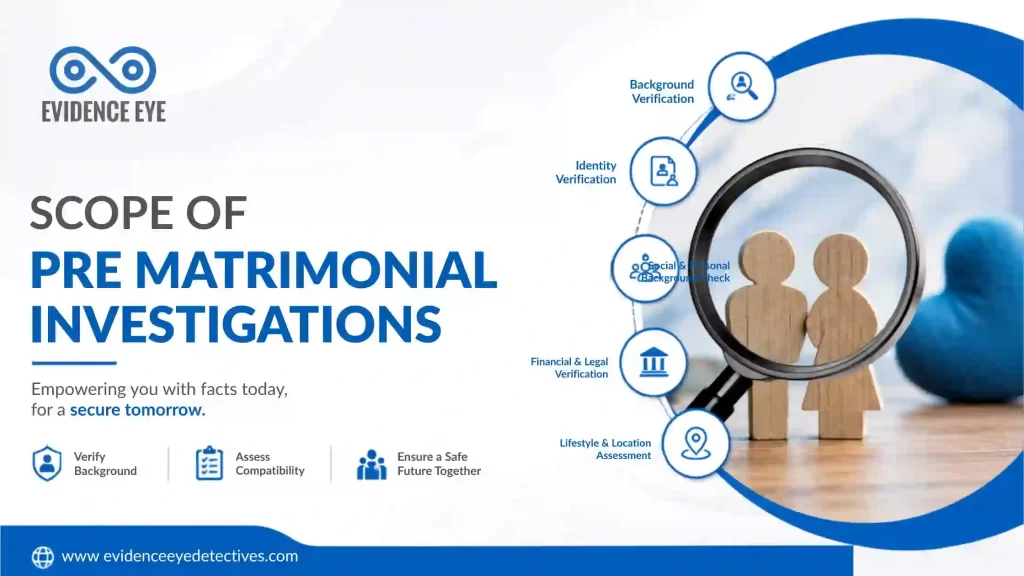
The scope of pre matrimonial investigation typically covers eight areas: identity verification, family background, education and employment, financial status, criminal and legal records, medical and mental health history, past relationships or marriages, and character or lifestyle habits. Investigators gather this information through discreet background enquiry, field surveillance, and public record checks — while staying within legal boundaries that exclude phone tapping or hacking private accounts.
Let’s look at each area in detail.
Why the Scope of Pre Matrimonial Investigation Matters
Not every case needs the same depth of checking. A family worried about a hidden marriage needs a different scope than someone concerned about financial dishonesty. Understanding the full range of what’s possible helps you:
- Ask for exactly what you need, instead of paying for an unfocused, generic check
- Set realistic expectations about what the final report will and won’t tell you
- Choose an agency whose expertise matches your specific concern
- Avoid unnecessary intrusion into areas that don’t matter to your decision
If you’re new to this process, our guide on how pre matrimonial investigation work explains the step-by-step method agencies use. This article focuses specifically on what gets investigated, not how.
The 8 Core Areas Covered Under the Scope of Pre Matrimonial Investigation
1. Identity Verification
Every investigation starts here. Investigators confirm the subject’s real name, age, address, and identity documents. With matrimonial apps and online profiles becoming the norm, misrepresented age, fake job titles, and false identities are more common than most people expect. This step establishes a factual baseline before anything else is checked.
2. Family Background and Social Reputation
The scope extends beyond the individual to their family. This includes:
- Family reputation in the neighborhood and community
- Relationship dynamics with parents and siblings
- History of family disputes, litigation, or social controversy
- General temperament and behavior of close family members
Since marriage in most cultures means joining two families, this area often carries as much weight as the individual’s own background.
3. Education and Employment Verification
Investigators verify whether educational qualifications, degrees, and job details match what’s been claimed. Fake degrees, inflated job titles, and exaggerated salaries are surprisingly common on matrimonial profiles. This part of the investigation confirms:
- Authenticity of academic certificates
- Current employer, designation, and actual salary
- Work conduct, punctuality, and professional reputation
4. Financial Status Assessment
Money problems are one of the leading causes of marital conflict, which is why financial due diligence sits squarely within this scope. This covers:
- Property, assets, and ownership records
- Existing loans, debts, and credit obligations
- Overall financial stability and spending patterns
- Any history of bankruptcy or unmet financial obligations
This check protects against cases where someone misrepresents their wealth to gain acceptance from an affluent family, or hides serious debt until after the wedding.
5. Criminal and Legal Record Check
A thorough investigation checks for any pending criminal cases, past convictions, or ongoing civil litigation involving the subject or their immediate family. This is one of the most critical parts of the scope, since undisclosed legal trouble can have serious consequences after marriage — from financial liability to reputational risk.
6. Medical and Mental Health History
This is a sensitive but important area. Investigations may uncover undisclosed serious physical conditions, mental health disorders, or dependency issues such as alcohol or drug addiction, where such information is legally accessible and relevant. Concealing a serious health condition out of fear of losing a match is unfortunately common, and this check exists to prevent that shock from surfacing after the wedding rather than before it.
7. Past Relationships and Marital History
The scope also includes verifying whether the subject has been previously married, is currently separated, or has undisclosed children from an earlier relationship. Investigators also look into significant past relationships that could be relevant to compatibility or trust — such as a pattern of broken engagements or hidden ongoing relationships.
8. Character, Habits, and Lifestyle
Finally, investigators assess day-to-day behavior and character traits through discreet enquiry and, where required, field surveillance. This includes:
- Habits like drinking, smoking, or gambling.
- General temperament and social conduct.
- Existing relationships or signs of an ongoing affair.
- Social media activity and digital footprint, to cross-check claimed lifestyle against actual behavior.
What Falls Outside the Legal Boundaries of Investigation?
Just as important as knowing what’s covered is knowing what isn’t — and shouldn’t be. A licensed, professional detective agency will never offer to:
- Tap phone calls or access private call detail records (CDR).
- Hack email, social media, or messaging accounts.
- Intercept private conversations without consent.
- Trespass on private property to gather evidence.
Any agency promising these services is operating outside Indian law, and evidence obtained this way is not admissible if the findings are ever needed in a legal proceeding. A trustworthy agency sticks to public records, visual surveillance in public spaces, and voluntary interviews — the same legal boundaries covered in our detailed breakdown of pre matrimonial investigation work.
What You Receive at the End: Report Deliverables Within Scope?
The scope of pre matrimonial investigation also determines what the final deliverable looks like. A basic verification package usually results in a short written summary confirming or flagging key facts — identity, employment, and education. A comprehensive investigation typically includes a detailed report covering every checked category, supported by documentary evidence where relevant, such as photographs from surveillance or copies of verified records.
Before the investigation begins, ask the agency what format the final report will take, whether it includes supporting evidence, and how findings on sensitive areas like health or past relationships will be presented. Clarifying this upfront ensures the deliverable actually matches the scope you paid for, rather than a generic summary that leaves your original questions unanswered.
Factors That Influence the Scope of Investigation
Several factors determine how wide or narrow an investigation needs to be:
- Type of marriage: arranged marriages often require broader family background checks, while love marriages may focus more on financial and past-relationship verification.
- Location of the subject: local cases allow deeper field surveillance; international or NRI cases rely more on document verification and coordination with local investigators.
- Specific client concerns: a focused case (say, financial transparency) needs a narrower, faster scope than an all-encompassing check.
- Time and budget constraints: comprehensive investigations take longer and cost more, so scope is often adjusted to match urgency.
- Source of the match: profiles sourced through matrimonial apps or unfamiliar social circles often warrant a wider scope than matches introduced through known family connections, since less prior context exists to verify against.
Benefits Of A Well-Defined Investigation Scope
- Faster turnaround: a focused scope means investigators aren’t chasing irrelevant details.
- Lower cost: you only pay for what actually matters to your decision.
- More actionable report: a report addressing your real concerns is easier to act on than a generic overview.
- Reduced intrusion: limiting scope to relevant areas respects privacy while still protecting your interests.
Best Practices When Deciding the Scope
- List your top 2–3 concerns first. Build the scope around those instead of asking for “everything.”
- Discuss legal boundaries upfront. Confirm the agency only uses lawful methods.
- Match scope to marriage type. NRI, arranged, and love marriage cases often need different emphasis.
- Ask for a written scope of work. This avoids confusion about what’s included in your package.
- Revisit scope if early findings raise new questions. Investigations can be expanded mid-process if something significant surfaces.
Conclusion
The scope of pre matrimonial investigations isn’t one-size-fits-all — it can be as narrow as verifying a job title or as broad as a full background, financial, and character assessment. Knowing exactly what falls inside that scope helps you ask the right questions, set the right expectations, and get a report that actually answers what you need to know before marriage.
If you’re planning a wedding and want a clear, customized investigation scope built around your specific concerns, Evidence Eye Detectives offers confidential, legally sound pre matrimonial verification services across India. Get in touch for a free, no-obligation consultation to define the right scope for your case.
FAQs
It typically includes identity verification, family background, education and employment checks, financial status, criminal record checks, medical and mental health history (where accessible), past relationships or marital history, and character or lifestyle assessment.
Yes, reviewing publicly available social media profiles and digital footprint is a standard part of a comprehensive investigation, used to cross-check a subject’s claimed lifestyle and relationships.
Yes. Family reputation, financial standing, and any legal disputes involving close family members are commonly included, since marriage in most cases involves both families.
It can be, where such information is legally accessible. This typically focuses on undisclosed serious health conditions or dependency issues that could significantly affect the marriage.
Most agencies offer tiered packages, and you can request a narrower or broader scope depending on your specific concerns and budget.
No. Phone tapping and accessing private call records without authorization are illegal in India. Any legitimate agency excludes these methods from its scope entirely.
For subjects living abroad, the scope shifts toward document verification, coordination with local investigators, and residency or employment confirmation in the relevant country, alongside standard checks conducted in India.