Every business, big or small, faces uncomfortable questions at some point. Is an employee leaking confidential information? Are the accounts showing unexplained gaps? Is a vendor working in the company’s interest, or against it?
When such doubts arise, the first decision is not what to find out. It is who should find it out. Some matters can be handled by your own HR, compliance or management team. Others may need an outside professional investigation agency.
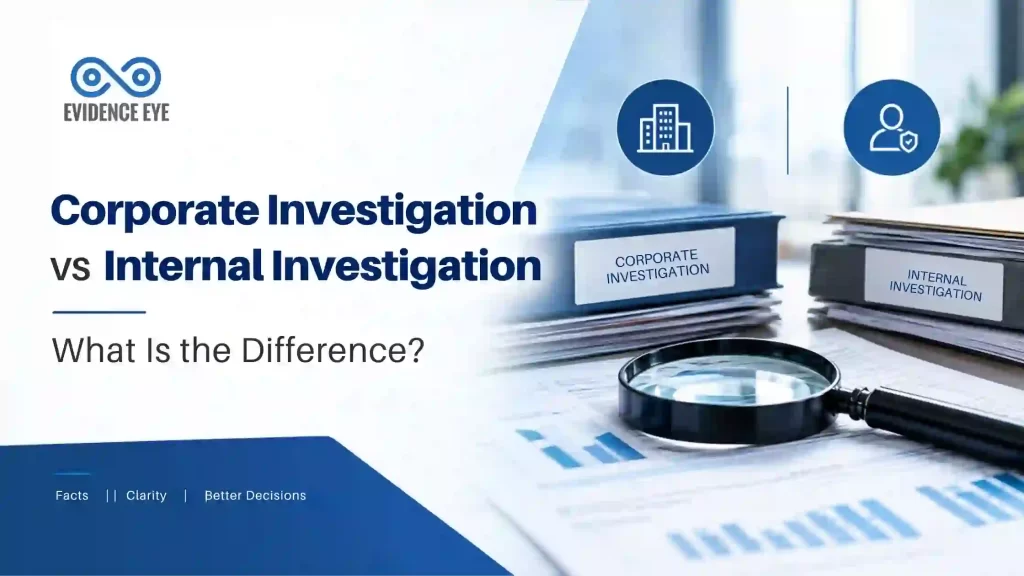
This is where the debate of corporate investigation vs internal investigation begins. Neither approach is always better. This guide explains both in simple terms, so you can decide with clarity.
What Is a Corporate Investigation?
A corporate investigation can be defined as a systematic fact-finding process involving the engagement of outside experts to look into a problem related to a business. This investigation process is commonly referred to as a business investigation and is undertaken by corporate investigators or private investigative agencies.
Companies make use of the corporate investigation services in situations where the issue they are facing is serious, intricate and delicate. Common examples of corporate investigations include:
- Suspicion of a case of corporate crime or employee crime
- Cases of financial discrepancies
- Theft of property of the company
- Leakage of sensitive business information
- Conflict of interests between employees and partners
- Doubts regarding the vendor, distributor or business partner
How Professional Corporate Investigators Work?
A good investigator does not work on assumptions. The job is to collect evidence, verify it, and present factual findings. This may include interviews, records review, field enquiries, open-source research and corporate intelligence gathering, all within the limits of applicable law. Three principles matter most:
- Evidence collection and documentation: Every finding should be backed by a record, a source or a verifiable observation.
- Confidentiality: A discreet investigation protects the business, the employees involved and the integrity of the process.
- Factual reporting: The final report should state what was found, not what someone hoped to find.
What Is an Internal Investigation?
An internal investigation is a fact-finding process handled by the organisation’s own people. It is sometimes called an internal inquiry or workplace inquiry. Depending on the company, it may be led by HR, the compliance team, senior management or in-house legal staff. Typical examples include:
- HR investigations into employee complaints
- Internal compliance investigations into policy violations
- Employee misconduct inquiries, such as harassment complaints or code-of-conduct breaches
- Attendance, behaviour or disciplinary matters
- Internal fact-finding before a management decision
The internal investigation process usually involves reviewing company records, speaking to the people concerned, documenting statements and preparing an internal report. The exact steps differ from one organisation to another, because they depend on company policy, size and structure.
Corporate Investigation vs Internal Investigation | Key Differences
The table below gives a factual comparison. It does not declare either approach superior, because each suits different situations.
| Factor | Corporate Investigation | Internal Investigation |
| Who conducts it | External professional investigators | Company’s internal team (HR, compliance, management) |
| Independence | External perspective, outside company hierarchy | Internal perspective, within company hierarchy |
| Expertise | Investigation-focused skills and experience | Depends on the skills of internal staff |
| Confidentiality | Managed by the external team | Managed within the organisation |
| Resources | May include specialist investigative resources | Usually limited to internal resources |
| Scope | Can cover complex matters, inside and outside the company | Usually focused on internal concerns |
| Evidence gathering | Professional investigative methods | Internal procedures and company records |
| Conflict of interest | May reduce internal conflict concerns | Possible if internal staff are connected to the issue |
| Reporting | Independent investigation report | Internal report |
| Best suited for | Complex, sensitive or discreet matters | Routine workplace or policy concerns |
When Should a Company Consider an Internal Investigation?
Internal investigations are usually warranted when the situation at hand is straightforward, the information is already available in records of the organization itself, and the procedure has already been covered in policies. For example:
- Complaints registered by employees against a particular grievance
- Transgression against the workplace rule
- Violations regarding attendance
- Internal disputes of minor nature
- Compliance checks that are routine
- Concerns where the HR policy has already been specified
Regardless of the way in which you proceed with the investigation, make sure that you comply with the policies of your organization along with abide by the local labor laws.
When Might a Company Consider a Corporate Investigation?
There are some instances when an external investigator is welcome. The following issues would benefit from the involvement of outside professional investigators:
- Indications of employee or business fraud.
- Strange financial discrepancies.
- Theft or misuse of the company’s assets.
- Indications of conflict of interest, e.g. employee helping a relative.
- Theft of information or misuse of proprietary information
- Misconduct of a senior manager
- Screening vendors or business partners prior to a serious transaction
- Issues dealing with background check of employees
- Cases where dealing with internal employees would present problems
- Some issues which need to be solved secretly
Can a Corporate Investigation and Internal Investigation Work Together?
Indeed, the two approaches are not necessarily contradictory. More often than not, both methods can complement and enrich each other. An external investigation agency can communicate with:
- HR for employee background verification.
- Management for business decisions.
- Legal department for legal review and possible follow-up.
- Compliance department for regulatory matters.
- Corporate security department for security and asset matters.
How Does a Corporate Investigation Work?
While every investigation case has its individual features, there are several similar steps common to any investigation:
- Initial consultation: The client states his/her concern briefly describing the case thus helping the investigator gather information.
- Setting the goal: Both sides define what should be achieved and what is not included.
- Investigation planning: The team makes plans determining what procedures and time frames will be used.
- Gathering information and data: This shall involve interviewing people, checking various documents.
- Verification and analysis: The findings shall be verified and confirmed from several sources.
- Obtaining the report: The observations and other important things obtained during the investigation are documented.
What Types of Corporate Issues Can Be Investigated?
Professional corporate investigation services cover many areas. Here are the most common.
Corporate Fraud Investigation
Looks into deception for financial or personal gain, such as false billing, embezzlement or manipulated records. A corporate fraud investigation aims to establish what happened, how, and who was involved, based on evidence.
Employee Misconduct Investigation
Examines serious breaches of conduct, such as abuse of position, moonlighting against company interest or repeated policy violations.
Background Verification
Confirms details a person has shared, such as identity, address and past records. Businesses use employee background verification to make informed hiring decisions. Learn more about our employee background verification service.
Employee Verification
Checks the claims of existing or prospective employees, including past employment, education and references.
Information Leakage Investigation
Traces how confidential data, pricing, client lists or trade information may have left the company.
Vendor and Business Partner Verification
Reviews the credibility and track record of suppliers, distributors and partners before or during a business relationship. This supports due diligence and reduces business risk.
Workplace Investigation
Looks into serious workplace concerns where an impartial outside view is needed, such as complaints involving senior leaders.
Asset or Property Investigation
Helps trace, verify or protect company assets where misuse or disputes are suspected.
Conflict of Interest Investigation
Checks whether an employee, director or manager has a personal interest that may influence company decisions.
Competitive Intelligence
Gathers lawful, publicly available market information to help businesses understand competitors and risks. This must always stay within legal and ethical limits.
Benefits of Using an External Corporate Investigation Agency
An external agency can add value in the right situation. The benefits are practical, not magical:
- Independent perspective: No internal relationships or office politics.
- Investigation-specific expertise: Trained people who do this work regularly.
- Discreet handling: Fewer people inside the company need to know.
- Specialised methods: Access to tools and techniques that an internal team may not have.
- Structured evidence collection: Organised records that support later decisions.
- Professional documentation: Clear, factual reports.
- Support for complex cases: Especially those spanning locations, vendors or digital records.
- Less burden on internal teams: HR and management can continue regular work.
No investigation can promise a particular outcome. A professional agency can offer a careful, evidence-based process.
What Should a Company Consider Before Choosing an Investigation Approach?
Use this checklist before deciding:
- Nature of the allegation: Is it a policy breach, or a suspected crime?
- Seriousness: What is the potential financial, legal or reputational impact?
- Internal resources: Do you have trained people and time?
- Required expertise: Does the case need forensic, field or research skills?
- Confidentiality needs: How sensitive is the matter?
- Conflict of interest: Is anyone on the internal team connected to the issue?
- Evidence available: Is it inside company records or spread outside?
- Scope: One person and one incident, or a wider pattern?
- Time sensitivity: Could delay lead to loss of evidence?
- Company policies: What do your HR and compliance policies require?
- Laws and regulations: What legal steps must be followed?
- Need for independence: Will your findings be questioned if handled internally?
Corporate Investigation vs Internal Investigation: Which Approach Is Appropriate?
There is no universal winner. The right approach depends on:
- The nature of the matter: Routine complaint or suspected fraud?
- Complexity: Are records, people and locations involved beyond the office?
- Sensitivity: Could exposure harm people or the business?
- Internal expertise: Does your team have investigation skills?
- Need for independence: Will stakeholders trust an internal finding?
- Policies and law: What is required or restricted?
Why Confidentiality Matters in Corporate Investigations?
Investigations deal with sensitive facts, reputations and sometimes people’s livelihoods. Careless handling can harm everyone involved, including the company. Good practice includes:
- Protecting sensitive business information such as financial records, client data and trade details.
- Respecting employee privacy, especially before findings are confirmed.
- Controlled access: Only authorised people should see investigation material.
- Secure documentation: Reports and evidence should be stored safely.
- Need-to-know communication: Share updates only with those who must act on them.
- Avoiding unnecessary disclosure: Rumours can damage trust and weaken an investigation.
Confidentiality practices should also follow applicable laws and your own company policies.
Need Professional Corporate Investigation Support?
If your business is dealing with suspected fraud, employee misconduct, verification needs or other sensitive concerns, you do not have to decide alone.
Evidence Eye Detectives is a professional investigation agency serving businesses and clients across India. Our team can discuss your requirements confidentially, help you understand your options and explain how an investigation could be structured.
Call us to discuss your requirement confidentially.
FAQs
An internal corporate investigation is a fact-finding action organized by an organization itself, such as HR, compliance or management department. The investigation involves the inquiry of complaints or violations of the applicable policies, as well as of other offenses. This is achieved through reviewing internal documents, interviewing employees, and applying other internal procedures. The investigation usually results in making the internal report and taking the managerial decision.
A corporate investigator conducts an inquiry into concerns connected with business activities, including corporate fraud, employee misconduct, theft, information leaks, conflicts of interest, and misuse of the property. The work also includes checking the background and the vendors and conducting the workplace inquiry, which requires the collection of proofs and verification of data to make the report.
Yes. External investigators frequently cooperate with HR, management, legal, and compliance departments as well. It is recommended to clarify such questions as the division of functions, the rules of confidentiality, the use of evidence, and the reporting procedures before starting the investigation. Thus, the HR department can continue working while conducting the investigation.
There is no standard timeframe. A straightforward verification might only take days, while a complicated fraud case can take weeks or months. The timeframe is dependent on the complexity of the case, the availability of the evidence, how many people and locations there are. A good investigator, under the circumstances, will give a rough idea of how long it will take.
Professional corporate investigations are intended to be secretive. Only authorized personnel have access to the material, evidence is stored safely, and sharing of information is limited to those in need. Confidentiality must be discussed from the very beginning between the client and the agency.
Essentially, the client needs to give a short overview of the problem, the parties involved, dates, documents in possession of the agency, and what the agency needs to find out. If information is not complete, discussion may enable to determine the next steps and scope of the investigation.