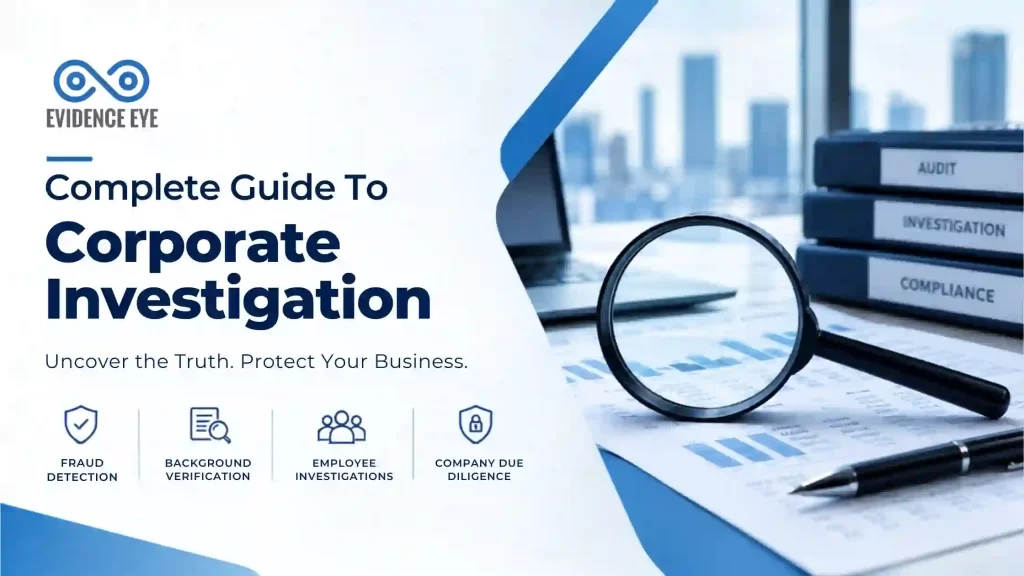
Running a business involves more than managing employees, customers, and finances. At times, a company may face situations where something does not seem right. Money may be missing, an employee may be sharing confidential information, a business partner may not be completely transparent, or a vendor’s background may raise concerns. In such situations, businesses need facts rather than assumptions. This is where Corporate Investigation can help.
A corporate investigation is a professional process used to examine suspected fraud, misconduct, information leaks, employee concerns, business partner issues, and other risks affecting a company. The purpose is to collect and verify relevant information so that business owners and management can make informed decisions.
This guide explains what corporate investigation means, why companies may need it, the common types of investigations, how the process works, and when a business should consider professional investigation services.
What Is Corporate Investigation?
Corporate investigation is the process of finding out the truth behind a specific business concern, fraud, misconduct, or something that just doesn’t add up. It relies on facts and evidence, not guesswork.
It’s different from an audit, which checks whether processes were followed correctly on a routine basis. An investigation starts because someone already suspects something is wrong and wants it confirmed or ruled out.
It’s also more focused than everyday compliance work. Instead of applying a general checklist, an investigator digs into one specific issue — an employee, a vendor, a transaction — using enquiry and verification methods that go beyond normal internal processes.
Confidentiality matters throughout, since the information involved is often sensitive and unproven. In short, corporate investigation takes a business from suspicion to evidence.
Why Do Businesses Need Corporate Investigation?
Nobody commissions an investigation on a whim. There’s usually a specific trigger — a number that doesn’t reconcile, a complaint that won’t go away, a decision too big to make on trust alone. The reasons vary quite a bit in practice, but a few come up again and again:
- Employee fraud: Inflated expense claims, tampered records, funds going where they shouldn’t.
- Financial misconduct: Transactions that don’t fit the pattern, cash flow that doesn’t make sense.
- Internal theft: Stock or company property going missing without explanation.
- Corporate espionage: A competitor or insider getting hold of confidential business information.
- Data or information leaks: Client lists or pricing strategy ending up somewhere it shouldn’t.
- Employee background concerns: A resume or credential claim that doesn’t quite check out.
- Vendor or partner verification: Confirming a supplier is actually who they say they are.
- Conflict of interest: a manager quietly benefiting from decisions they’re supposed to make objectively.
- Intellectual property misuse: Designs or processes being used without permission.
- Workplace misconduct: Harassment complaints that need a genuinely independent look.
- Due diligence before big decisions: Mergers, investments, partnerships that deserve more scrutiny than a handshake.
Common Types Of Corporate Investigation
“Corporate investigation” is really an umbrella term. Underneath it sit several distinct types of work, each suited to a different kind of problem.
Employee Fraud Investigation
This comes up when a company suspects an individual employee of misusing funds or manipulating records for personal benefit. The work usually involves going through documentation, looking at transaction patterns, and making quiet enquiries to see whether the suspicion actually holds up.
Corporate Fraud Investigation
A step up in scale from employee fraud — this covers schemes that involve more than one person, sometimes external parties too, and often more complex financial structuring. The focus is on tracing how the fraud was executed and who was involved at each stage.
Background Verification
Standard practice before a hire, a promotion, or a partnership. It’s about checking whether what someone has claimed — their education, their work history, their credentials — actually matches reality.
Employee and Staff Verification
Close cousin of background verification, but often applied to people already on the payroll rather than incoming candidates, usually when there’s a specific concern about conduct or claims that need confirming.
Vendor and Business Partner Verification
Before signing anything long-term, many businesses want independent confirmation that a vendor or partner is financially sound and reputationally what they claim to be — not just what’s on their letterhead.
Corporate Espionage Investigation
Relevant when a business suspects a competitor, a former employee, or even someone still on the inside is accessing or passing along confidential strategic information.
Intellectual Property Investigation
Comes into play when a company believes its designs, processes, or proprietary content are being copied or used without authorisation.
Workplace Misconduct Investigation
Applies to harassment complaints or ongoing disputes that genuinely need a neutral set of eyes — not something HR alone can always deliver, particularly when the people involved know each other well.
Due Diligence Investigation
Carried out ahead of major decisions — mergers, acquisitions, new investments — to check claims and surface risks before serious money or reputation is on the line.
Asset and Financial Investigation
Focused on tracing assets or understanding someone’s real financial position, which tends to matter most in disputes or high-stakes negotiations where the numbers on paper don’t tell the whole story.
How Does A Corporate Investigation Work?
A corporate investigation usually follows a simple step-by-step process:
- Understand the Problem: The investigator first understands the company’s concern, such as fraud, employee misconduct, information leaks, or a suspicious business partner.
- Plan the Investigation: The investigator decides what needs to be checked and how the investigation will be carried out.
- Collect Information: Relevant information is gathered from available records, documents, online sources, and other lawful sources.
- Conduct the Investigation: Depending on the case, investigators may carry out discreet enquiries, employee verification, surveillance, or interviews.
- Verify the Information: The collected information is checked carefully to separate facts from assumptions.
- Prepare a Report: The findings and supporting evidence are organised into a clear investigation report.
- Share the Findings: The investigator explains the findings to the client, helping the business make a better-informed decision.
What Can A Corporate Investigator Investigate?
Within lawful limits, the scope typically includes:
- Employee activity tied to a specific concern or complaint.
- Business partners and whether their claimed credentials hold up.
- Vendors and suppliers, including whether they’re operationally legitimate.
- Financial irregularities and transaction patterns that look off.
- Indicators of fraud, such as documentation that doesn’t line up.
- Conflicts of interest that haven’t been disclosed.
- Suspected leaks of information or data.
- Misrepresented facts, qualifications, or business claims.
- Background details relevant to a hiring or partnership decision.
- Suspicious activity flagged internally by staff or management.
- Possible misuse of company resources or assets.
When Should a Business Consider Hiring a Corporate Investigation Agency?
Some situations announce themselves fairly loudly. Others build up quietly over months before anyone says anything out loud. Signs worth paying attention to include:
- Money that’s missing with no clear explanation.
- An employee whose behaviour around access or spending feels off.
- Information or client data leaking out more than once.
- Losses that keep tracing back to one particular vendor.
- A nagging feeling about a business partner’s background or intentions.
- Credentials or work history that don’t seem to check out.
- Internal suspicion of fraud that hasn’t been formally confirmed either way.
- A pattern suggesting a competitor knows more than they should.
- Misconduct complaints that keep recurring despite internal action.
- A major decision — funding, a partnership, an acquisition — that needs more than a surface-level check.
Benefits Of Hiring Corporate Investigation
Done well, corporate investigation gives a business a few genuinely useful things:
- Better decision-making, grounded in verified facts instead of guesswork.
- Earlier identification of risk, before it turns into a much bigger problem.
- Protection of business interests — financial, reputational, and otherwise.
- Fewer financial losses, simply because fraud gets caught sooner.
- Stronger due diligence, particularly before big-ticket decisions.
- Evidence to act on, which matters a great deal if things later go to HR or legal.
- Discreet handling of sensitive matters, protecting people’s reputations until something is actually proven.
- Relationships that survive the process, because concerns get resolved quietly rather than through public accusation.
Corporate Investigation vs Internal Investigation
Most businesses already have HR, compliance, or audit functions in place. So where does an external investigator actually add value?
| Function | Best suited for | Limitations |
| Internal HR/Compliance | Policy violations, routine grievances, procedural issues | Often lacks the independence or training for complex cases |
| Auditors | Financial accuracy, regulatory compliance | Built for record accuracy, not active fraud detection |
| Legal professionals | Legal risk, contracts, litigation strategy | Not typically set up for field verification or evidence-gathering |
| External corporate investigators | Independent fact-finding, sensitive or high-stakes matters | Works best alongside legal and compliance, not as a replacement for them |
Why Confidentiality Matters in Corporate Investigations?
Almost nothing in a corporate investigation is casual information. You’re dealing with someone’s conduct, a partner’s finances, an allegation that hasn’t been proven, or trade secrets that could hurt the business if they got out.
Confidentiality does a few jobs at once. It protects the person being looked into from reputational damage before anything’s actually confirmed. It keeps the business from tipping off the very person they’re trying to understand. And it protects the process itself — investigations run quietly tend to produce more reliable results than ones everyone already knows about.
A responsible agency keeps access to information limited to what’s genuinely necessary, sticks to lawful methods throughout, and shares findings only with the client — never with outside parties, and never through means that could put anyone’s legal standing at risk.
How To Choose A Corporate Investigation Agency
Investigation services aren’t all cut from the same cloth, and the differences tend to show up exactly when they matter most. A few things worth checking before you commit:
- Actual experience with corporate cases, not just personal or matrimonial work rebranded.
- Trained, professional investigators, not informal contacts working off the books.
- Straight talk about what’s realistic, no promises of guaranteed outcomes.
- Real confidentiality practices, with findings shared only with you.
- Reporting that separates fact from assumption, clearly and honestly.
- Lawful, ethical methods, no vague promises about “accessing anything”.
- A working understanding of corporate context, how fraud actually unfolds, what due diligence needs to cover.
- Scope and expectations set upfront, before any work begins.
- Reach beyond one city, useful if your vendors or partners are spread across states.
Conclusion
Suspicion by itself doesn’t fix anything, it just sits there, unresolved. Corporate investigation exists to close that gap, turning a vague worry into something concrete: verified facts a business can actually act on.
Whether it’s a fraud concern that won’t go away, a vendor you can’t quite pin down, or a partnership that needs more scrutiny before the ink dries, proper investigation gives you something internal checks often can’t — independence, discretion, and evidence you can stand behind.
If your business is sitting with a concern that needs a careful, confidential look, Evidence Eye Detectives can talk you through what’s realistic and how the process would work for your situation.
Get in touch for a confidential consultation whenever you’re ready.
FAQs
What is corporate investigation?
Corporate investigation is the process of gathering facts and lawful evidence to look into suspected fraud, misconduct, or irregularities connected to a business. It helps a company confirm or rule out a concern using verified information rather than assumptions.
Why do companies hire corporate investigators?
Mostly because internal checks have hit a wall — the concern is too specific, too sensitive, or involves someone outside the organisation. Investigators bring independence and enquiry methods that internal teams usually aren’t equipped for.
What does a corporate investigator investigate?
Typically employee conduct, financial irregularities, vendor and partner backgrounds, suspected leaks, and due diligence concerns — all through lawful verification and evidence-gathering.
How long does a corporate investigation take?
It really depends on the case. A simple background or vendor check might take a few days. A detailed fraud or due diligence investigation can run into weeks, especially if cooperation is limited.
Is corporate investigation confidential?
Yes, a professional agency handles everything discreetly and shares findings only with the client, protecting both the business and the people involved until something is actually confirmed.
What is the difference between corporate investigation and an audit?
An audit checks whether financial records followed the right procedures. Corporate investigation starts from a specific suspicion and focuses on finding out what actually happened, using enquiry and evidence rather than routine record review.
How can a business hire a corporate investigation agency?
Most agencies start with a confidential conversation to understand the concern, then agree on scope, timeline, and cost before any work begins.