Knowing the truth about your cheating spouse, a lying business associate, or a lost loved one is difficult enough without having to ask yourself whether you are doing things correctly. Eventually, most people find themselves wondering the same thing: should I hire a private detective, or is it something that I could do myself?
And this is precisely where the dilemma between hiring a private investigator and conducting the investigation yourself enters into play. They are both possible solutions. They both give you the same result, a clear picture of the situation. However, they are far from being equally legal, effective, safe and affordable.
This article will help you make an informed decision.
What Is DIY Investigation?
DIY verification means just what it implies,
the individual conducting their investigation themselves and figuring out the truth without a license, training, or even the proper equipment. The first things most people do when conducting such an investigation include scrolling through Instagram accounts and doing a simple Google search of names or even public records for businesses.
In certain cases, this proves to be all that is needed; in others, the starting point of a lot more trouble than expected.
Who Are Private Detectives?
A private detective is a licensed professional who’s spent years learning how to investigate the right way — legally, quietly, and with evidence that holds up. That last part is the piece most people underestimate. It’s not just about finding out what happened. It’s about proving it in a way that protects you afterward.
Where a DIY search stops at “I have a feeling,” a trained investigator knows how to turn that feeling into documented, verifiable fact — without crossing a legal line in the process. That’s really the heart of the difference between hiring a private detective and doing it yourself: one relies on instinct and public information, the other relies on training, resources, and accountability.
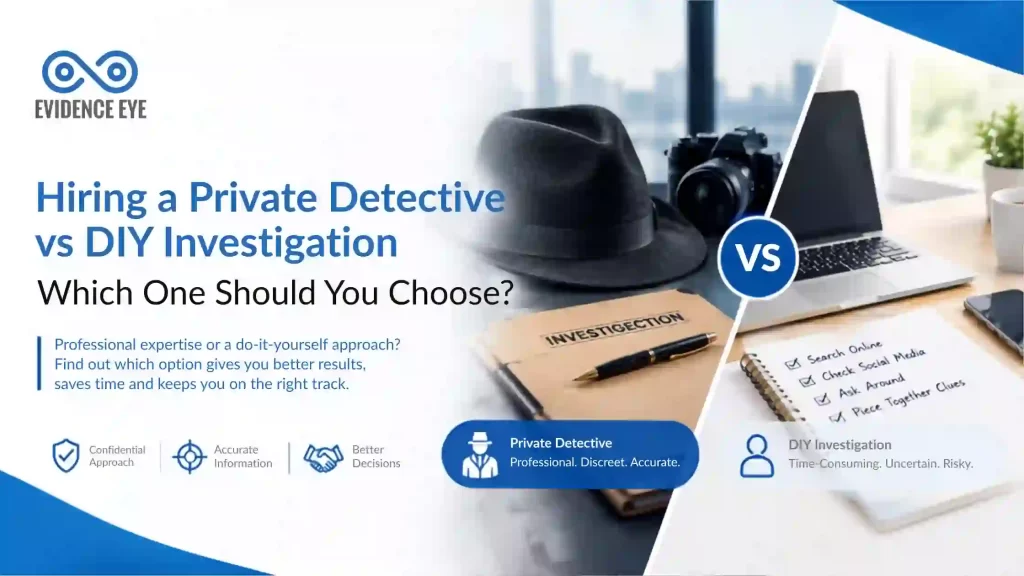
Hiring A Private Detective vs DIY Investigation: Side-by-Side Comparison
| Factor | DIY Investigation | Hiring a Private Detective |
| Upfront Cost | Low or free | Service fee applies |
| Legal Risk | High — laws are easy to unintentionally break | Low — investigators work within legal boundaries |
| Evidence Quality | Often weak or inadmissible in court | Documented properly, usable in legal proceedings |
| Time Required | Weeks to months, with no guarantee | Typically faster, with focused methods |
| Safety | Personal risk in confrontations | Trained to avoid dangerous situations |
| Access to Tools/Databases | Limited to public information | Access to specialized resources and networks |
| Emotional Objectivity | Difficult, since you’re personally involved | Neutral, professional perspective |
| Best Suited For | Simple, low-stakes verification | Matrimonial, corporate, legal, and sensitive cases |
Why Do People Consider DIY Investigation First?
Honestly, it makes sense. Before anyone picks up the phone to call an investigator, they try to figure it out on their own. There’s usually a mix of reasons behind it.
- Money: Investigation services can feel like a big expense upfront, so spending a few evenings on your own research seems like the cheaper route.
- It feels too personal to outsource: When it’s your marriage, your family, or your business on the line, handing it over to a stranger can feel uncomfortable — even wrong.
- Technology makes people overconfident: Between Google, Facebook, and a dozen “find anyone” websites, it genuinely feels like the internet has all the answers.
- TV doesn’t help: Every crime drama makes investigation look fast and dramatic — a few clever moves and the truth just appears. Real life rarely works that way.
All of these reasons are understandable. But they tend to fall apart the moment the situation gets even slightly complicated, and that usually happens faster than people expect.
When Does DIY Investigation Might Actually Work?
Not every DIY attempt ends badly. Self-investigation can be reasonable when the stakes are low and the information you need is publicly available.
- Verifying a dating profile: checking if a name, photo, or job matches what someone claims on social media.
- Basic background screening: confirming a person’s employer, education, or general identity through LinkedIn or public records.
- Simple vendor or business checks: reading Google reviews, checking Better Business Bureau-style complaints, or confirming a registered address.
These situations involve no confrontation, no legal risk, and no evidence that needs to survive a courtroom. If your need fits into this category, some independent research is fine. The moment the matter becomes personal, financial, legal, or potentially dangerous, DIY stops being a smart option.
Where Does DIY Investigation Go Wrong?
This is the part most people underestimate — and it’s the core reason the comparison between hiring a private detective vs DIY investigation matters so much.
1. Legal Trouble You Didn’t See Coming
Most individuals have no real understanding of surveillance and privacy laws. Following someone repeatedly, photographing them without consent, or accessing their phone, email, or financial accounts without authorization can cross into stalking, harassment, or privacy violation — even with good intentions. “I didn’t know it was illegal” rarely helps once a complaint is filed.
2. Personal Safety Risks
Confronting a cheating spouse, tailing a suspicious employee, or approaching someone involved in fraud can turn dangerous fast. Trained investigators know how to observe from a safe distance, when to disengage, and how to avoid direct confrontation. Untrained individuals often don’t realize the risk until they’re already in it.
3. Weak or Unusable Evidence
Even if you find what you were looking for, the way it was collected matters. Evidence gathered illegally, without proper documentation, or without a clear chain of custody is often thrown out — or worse, used against you — in court or custody proceedings. Photos and screenshots alone rarely meet legal evidentiary standards.
4. Wasted Time and Emotional Strain
DIY investigation can stretch across weeks or months of frustrated searching, especially when the person being investigated is careful. On top of that, investigating someone close to you — a spouse, a business partner, a relative — is emotionally exhausting. Staying objective while personally invested is extremely difficult.
What You Get When You Hire a Private Detective?
A licensed private detective brings resources, training, and legal knowledge that simply aren’t available to the average person. Here’s what changes when you bring in a professional.
- Legal expertise: Professionals understand surveillance, privacy, and evidence laws in detail, so investigations stay within legal boundaries from start to finish.
- Trained surveillance skills: Surveillance investigation requires patience, discretion, and the right equipment — skills built over years of fieldwork, not something learned overnight.
- Access to specialized resources: Investigators can access verified databases, professional networks, and tools that are simply unavailable to the public.
- Court-admissible documentation: Every photo, video, and report is collected and documented in a way designed to hold up during divorce, custody, insurance, or fraud proceedings.
- Faster, more accurate results: What might take an untrained person weeks of guesswork, an experienced investigator can often uncover in a matter of days.
- Objectivity: A professional stays emotionally detached, which means clearer judgment and a more thorough investigation — free from personal bias.
The Real Cost Comparison: DIY vs Professional Investigation
On paper, DIY looks cheaper. In practice, the total cost often works out differently once you factor in everything beyond the sticker price.
- Your time has value: Dozens of hours spent researching or following someone add up, especially if you have a job and family responsibilities.
- Legal costs from mistakes: A single privacy or stalking complaint can lead to legal fees that dwarf the cost of hiring a professional in the first place.
- The cost of getting it wrong: In cases involving hidden assets during a divorce, employee fraud, or child custody, incomplete or inaccurate information can cost far more than any investigation fee.
- Emotional cost:. Investigating someone close to you, without support or objectivity — takes a real toll on mental well-being.
When you weigh all of this against a professional’s fee, hiring a private investigator often turns out to be the more economical choice, not the more expensive one.
Situations Where You Should Always Hire a Professional
Certain cases carry too much risk for a DIY approach, regardless of budget.
- Matrimonial concerns: Suspected infidelity, or verifying a partner’s background before marriage. A matrimonial investigation service handles this with discretion and legally sound methods.
- Corporate and workplace fraud: Employee theft, embezzlement, or due diligence before a business partnership. Corporate investigation services are built specifically for this.
- Legal proceedings: Divorce, child custody, or insurance disputes where evidence must be court-admissible.
- Missing person cases: These require trained search techniques, official contacts, and speed that DIY efforts cannot match.
- Anything involving potential danger: Situations where confrontation, criminal activity, or personal safety could be at risk.
If your situation fits any of these, don’t wait to see how far DIY research can take you — the risk isn’t worth it.
Conclusion
Weighing hiring a private detective vs DIY investigation really comes down to one question: what’s actually at stake? For small, low-risk checks, doing it yourself is reasonable. But when the outcome affects your marriage, your finances, your business, or your safety, cutting corners rarely pays off.
A professional brings legal protection, trained skills, and evidence that actually holds up — things no amount of internet searching can replace. If your situation feels bigger than a quick Google search can solve, it probably is.
Need clarity on a sensitive situation?
Get in touch with Evidence Eye Detectives for a confidential consultation, and let experienced investigators handle it the right way — legally, safely, and discreetly.
FAQs
Not always illegal, but it becomes risky quickly. Following someone repeatedly, accessing private accounts, or trespassing can violate privacy and harassment laws. Public information research is generally fine; anything involving surveillance or personal accounts is not.
DIY looks cheaper at first, but it comes with hidden costs — legal risk, wasted time, evidence that might not even be usable. Professional fees vary depending on the case, but once you factor everything in, it often works out to be the smarter spend.
Usually not on its own. Courts want evidence that’s been collected legally and documented properly. A few screenshots or photos taken without following the rules often get challenged or thrown out entirely.
Honestly, it’s a confrontation. A lot of people who try to catch a partner in the act end up in a dangerous or emotionally charged situation they didn’t see coming. A professional can get you the same proof, often more reliably, without putting you in that position.
Whenever there’s a real chance the case ends up in legal proceedings, involves fraud or infidelity, a missing person, workplace misconduct, or anything where safety or solid evidence genuinely matters.
No honest agency will promise a specific outcome — every case is different. What they can promise is a process that’s legal, thorough, and handled with care from start to finish.